

The pharmaceutical manufacturing process is the foundation for producing safe, effective and high-quality pharmaceuticals to fulfill the healthcare demands of millions of people around the world. Every tablet, capsule, or oral liquid formulation undergoes a carefully managed manufacturing process from formulation through to completion. Each step from formulation development and raw material selection to commercial production, quality testing, and packaging is crucial for maintaining product quality, consistency, and regulatory standards.
Pharmaceutical manufacturing, as opposed to much of the manufacturing industry, is among the world’s most regulated industries. Manufacturers must adhere to rigorous quality control, validated methods, and thorough documentation throughout the manufacturing process. Regulatory frameworks like World Health Organization Good Manufacturing Practices (WHO-GMP) help ensure pharmaceutical products are manufactured under controlled conditions, reducing risks and protecting patient safety.
Beyond the regulatory requirements, there are growing expectations for modern pharmaceutical companies. They need to shorten product development cycles, scale up production efficiently, maintain supply chain reliability, and meet quality requirements in various international markets. The ability to meet these goals depends not only on sophisticated manufacturing equipment, but also on the expertise and experience of a partner in formulation development, technology transfer, quality assurance, and commercial manufacturing.
Understanding the pharmaceutical manufacturing process helps pharmaceutical companies, healthcare brands, and product owners to make better decisions when selecting a manufacturing partner. An understanding of each manufacturing step also contributes to the enhancement of product quality, speedy commercialization, and reduced manufacturing risks.
This guide outlines the entire pharmaceutical manufacturing process, from formulation development through to commercial production, including quality control, regulatory compliance, packaging, and distribution.
What is Pharmaceutical Manufacturing?
Pharmaceutical manufacturing is the process of producing pharmaceutical products by combining active pharmaceutical ingredients (APIs) sourced from qualified suppliers and carefully selected excipients to ensure the product is safe, effective and stable in its dosage form. Finished products may include tablets, capsules, oral liquid preparations, powders, and other pharmaceutical preparations for patient use.
The main goal of pharmaceutical production is to consistently produce medicines that meet quality, safety, efficacy, and regulatory requirements. Each stage of the manufacturing process is designed to guarantee that every batch will have an identical composition, strength, purity, and performance throughout the batch’s shelf life.
The pharmaceutical manufacturing industry is an important part of the global healthcare system. It supports the introduction of innovative medicines, production of generic medicines, access to healthcare, and contributes to the increasing demand for quality pharmaceutical products in national and international markets.
The terms pharmaceutical manufacturing and pharmaceutical product development are used interchangeably, but they are two separate steps in the process of developing a pharmaceutical product.
The process of pharmaceutical product development involves designing and optimizing a product formulation to achieve the desired therapeutic effect. This step includes scientific research, pre-formulation studies, selection of excipients, development of analytical methods, stability studies, and development of prototype formulations.
In pharmaceutical manufacturing, on the other hand, the manufacturing process begins when a formulation is successfully developed and validated. It involves transforming that formulation into commercial-scale production with standardized manufacturing processes, validated manufacturing equipment, quality systems and regulatory documentation with the aim of ensuring batch-to-batch consistency.
Successful pharmaceutical manufacturing relies on the seamless integration of scientific formulation knowledge, manufacturing processes, quality control, and regulatory compliance to produce products consistently that satisfy market expectations.

Role of Formulation Development in Pharmaceutical Manufacturing
All successful pharmaceutical products start long before commercial manufacturing begins. Formulation development is one of the most important steps in the pharmaceutical manufacturing process, where scientific research is converted into a stable, effective, and manufacturable product.
The main objective of formulation development is not only to blend the ingredients together into a formulation but also to develop a formulation that provides the desired therapeutic action and is stable, safe, and appropriate for commercial manufacturing. Choices made during this stage can affect the efficiency of manufacturing, regulatory clearance, product performance and ultimate market success.
Pre-formulation Studies
The formulation development process starts with pre-formulation studies, which involve scientists evaluating the physical and chemical properties of the active pharmaceutical ingredient (API). These studies help determine important properties like solubility, stability, particle size, moisture sensitivity, compatibility with excipients, etc.
Understanding these properties helps formulation scientists choose the correct manufacturing methods and avoid possible problems in later stages of development.
Excipient Selection
Excipients are inactive ingredients that are necessary for the pharmaceutical formulation. They can improve the stability of the product, aid drug release and tablet compression, improve taste, or improve patient acceptability, depending on the dosage form used.
The choice of excipients must be carefully evaluated with regard to their compatibility with the API, manufacturing process, regulatory requirements, and intended product use. The selection of excipients can have an impact on the product quality, stability, and manufacturing uniformity even for minor changes.
Prototype Formulation Development
After suitable excipients have been identified, scientists work on several prototype formulations in order to find the most suitable formulation. These prototype batches are then extensively tested to evaluate critical quality attributes including dissolution, hardness, friability, uniformity, viscosity, and product performance.
The iterative development process allows formulation scientists to optimize the formulation before moving to commercial manufacturing.
Analytical Method Development
Analytical methods must be reliable and applicable to the assessment of pharmaceutical products during development and manufacturing processes. Analytical method development is the development of validated methods for the determination of identity, assay, impurities, dissolution, microbial limits, and other quality parameters.
Validated analytical methods help ensure that all stages of the manufacturing process can be monitored and controlled with the required accuracy and meet regulatory requirements.
Stability Studies
Stability studies evaluate the performance of a pharmaceutical product over time under a variety of environmental conditions. The products are tested under different temperature and humidity conditions to assess shelf life, packaging suitability, storage guidelines, and long-term product stability.
These studies provide valuable information for regulatory submissions and also ensure that the product is safe, of high quality, and effective over its shelf life.
Why Formulation Development Matters
Successful pharmaceutical manufacturing begins with successful formulation development. A good formulation contributes to consistent product quality, the efficiency of manufacturing, minimising production variability, and technology transfer for commercial scale-up.
On the other hand, if the formulation is not developed properly, the manufacturing issues include difficulty in tablet compression, variation in dissolution, degradation, high batch rejection rates, or delays in the approval process.
An established formulation development team can be helpful for pharmaceutical companies looking to launch new products or enhance their current formulations, as it can improve the chances of commercialization success while also streamlining development schedules.
Formulation development is part and parcel of a product development lifecycle at Octavius Pharma. The team brings together scientific know-how and manufacturing experience to create strong formulations that not only perform well in the laboratory, but also support efficient commercial production and long-term regulatory assurance.

Key Stages of the Pharmaceutical Manufacturing Process
After successful pharmaceutical formulation development and validation, the product goes through commercial manufacturing. This is a sequence of well-controlled processes that result in the consistent production of pharmaceutical products that satisfy predetermined quality, safety, and regulatory requirements.
While the manufacturing process might differ from one dosage form to another and from product to product, there is a general workflow that most pharmaceutical products share. All stages are carried out in accordance with validated procedures, with thorough documentation and under strict quality control protocols to maintain product consistency and ensure patient safety.
Procurement and Quality Verification of Raw Materials
The pharmaceutical manufacturing process starts with procurement of high-quality raw materials from qualified and approved suppliers. These materials consist of active pharmaceutical ingredients (APIs), excipients, packaging materials, and other materials required for production.
Supplier qualification is a crucial component of pharmaceutical manufacture, given that the quality of the finished product is dependent on the quality of the material received from suppliers. Suppliers are assessed by the manufacturer based on quality systems, regulatory compliance, manufacturing facilities, documentation, and consistency of supply.
The raw materials are then received at the manufacturing facility and a full incoming inspection of the raw materials is performed before production. All materials are tested against predefined specifications to ensure they meet the required material identity, purity, strength, microbiological quality, and physical properties. Other documents such as Certificates of Analysis (CoA), batch records, and supplier documentation are also checked to ensure complete traceability.
Materials that pass all quality requirements are approved for use in manufacturing. This systematic verification process aids in reducing the risk of manufacturing and ensures each manufacturing batch begins with materials of approved quality standards.
Manufacturing Planning
Pharmaceutical manufacturers conduct extensive manufacturing planning prior to production to guarantee that all manufacturing activities are conducted under controlled conditions.
Production teams prepare production schedules, allocate equipment, check availability of raw materials, and review production documentation. Standard Operating Procedures (SOPs), Batch Manufacturing Records (BMRs), equipment logbooks, cleaning records, and environmental monitoring data are also checked to ensure that manufacturing can proceed without deviations.
Equipment qualification and calibration are confirmed to ensure equipment is running within validated parameters. Manufacturing areas are cleaned and set up following the correct procedures to ensure there is no cross-contamination and product integrity.
Comprehensive planning improves the efficiency of the manufacturing operation and ensures that the manufacturing operation is conducted according to Good Manufacturing Practices (GMP) throughout the manufacturing process.
Granulation and Blending
Granulation is one of the most critical steps in the manufacture of many oral solid dosage forms. Granulation helps to improve the flowability of the powder, increase compressibility, prevent segregation, and ensure a uniform distribution of the active ingredients in the formulation.
Granulation methods can vary depending on product characteristics.
Wet granulation is a procedure in which the powders are mixed with a binding solution, granules are produced by drying the mixture, and then the granules are sized for the next stage of processing. This method is usually employed for formulations where greater compressibility and uniformity are desired.
For moisture-sensitive or heat-sensitive products, dry granulation is an alternative. It compacts powders without the use of liquids, which is ideal for formulations that might be affected by wet processing.
In addition, some formulations can be produced by direct compression, in which the APIs and excipients are blended and compressed without an intermediate stage of granulation. This can make manufacturing easier and shorten the processing time for appropriate formulations.
Following granulation, the material is further mixed with other excipients, lubricants, or glidants to ensure a uniform blend. Such uniformity is crucial, as it guarantees that each tablet or capsule will deliver the appropriate dose of the active ingredient, which can directly affect the product’s effectiveness and patient safety.
During this step, manufacturers conduct in-process tests to ensure blend uniformity and that critical process parameters remain within validated limits.
Tablet Compression or Capsule Filling
After successful blending, the final dosage form is prepared by tablet compression or capsule filling.
In tablet manufacturing, rotary compression machines exert carefully controlled pressure to yield tablets of uniform weight, hardness, thickness, and appearance. Compression parameters are continually monitored, ensuring product quality and minimizing product defects such as capping, lamination, and weight variation.
Capsule manufacturing is the process of precisely filling hard gelatin or HPMC capsules with the formulation. Advanced filling equipment guarantees a consistent fill weight and reduces product loss and dosage inaccuracies.
Operators routinely check critical quality attributes during production, such as tablet weight variation, tablet hardness, friability, disintegration, and capsule fill weight. These in-process quality checks allow manufacturers to detect deviations early and take corrective measures before large quantities are produced.
Therapeutic dosage uniformity is critical. Each patient should receive the intended therapeutic dose in every tablet or capsule.
Tablet Coating (Where Applicable)
After the compression process, many tablets are coated. Tablet coating is not a mandatory requirement for all tablets, but it provides a number of functional and aesthetic benefits.
Protective coatings shield tablets from moisture, oxygen, and light to ensure product stability throughout their shelf life. Some coatings also offer taste masking, helping patients take medications more easily.
Functional coatings can alter the release properties of the drug. For instance, enteric coatings prevent tablets from dissolving in the stomach, while controlled-release coatings allow the sustained release of active ingredients.
Coating also helps with product appearance, can facilitate product identification, reduce dust generation, and boost the mechanical strength of the product during handling, packaging, and transport.
Manufacturers monitor the following parameters during the coating process to guarantee consistency in product quality: spray rate, inlet air temperature, pan speed, and coating thickness.
Oral Liquid Manufacturing (Where Applicable)
Manufacturing of oral liquid formulations like syrups, suspensions, and solutions is also included in pharmaceutical manufacturing.
The manufacturing process starts with precise measurement and mixing of active ingredients, solvents, preservatives, sweeteners, flavoring agents, and other excipients according to validated formulations.
The mixture is gently agitated to ensure ingredients are completely dissolved or dispersed. Depending on the formulation, filtration can be used to remove particulate matter and improve product clarity.
After the formulation meets quality specifications, it is moved to automated filling lines, where the bottles are filled, capped, sealed, and labeled under controlled conditions.
Many quality checkpoints are performed throughout the production of oral liquids to ensure product consistency and compliance with quality specifications. These include appearance, pH, viscosity, microbial testing, fill volume verification, and assay testing.
Packaging and Labeling
Pharmaceutical product packaging is the last manufacturing step before the product is distributed.
In addition to product protection, pharmaceutical packaging is critical to ensure product stability, maintain traceability, and deliver necessary information to healthcare professionals and patients.
Pharmaceutical manufacturers may employ blister packs, HDPE bottles, glass bottles, strip packs, sachets, and other packaging formats that maintain the integrity of the product during storage and transportation.
All packaging materials are subjected to quality checks prior to packaging to ensure that they meet approved specifications. Automated systems and trained personnel verify product identity, batch numbers, manufacturing dates, expiry dates, labeling accuracy, and, where serialization is required, compliance with serialization requirements during packaging operations.
Strict line clearance procedures are implemented on packaging lines to avoid product mix-ups and ensure that all batches are traceable.
After packaging, all finished products are quarantined until all the quality control tests, documentation reviews, and batch release procedures have been completed.
Why Every Manufacturing Stage Matters
There are many stages in pharmaceutical manufacturing, which are all connected. The safety, consistency, and effectiveness of the finished pharmaceutical product depend on the quality attained in formulation development, raw material verification, manufacturing, packaging, and documentation.
These stages are not stand-alone processes but are embedded in an overall pharmaceutical quality system, with all processes validated, documented, monitored, and continually improved. The systematic approach ensures pharmaceutical manufacturers can consistently manufacture high-quality medicines that satisfy regulatory requirements and contribute to long-term commercial success.
Quality Control Throughout the Manufacturing Process
Quality is not checked only at the end of the pharmaceutical manufacturing process; it is maintained during each step of the process. Quality systems ensure that all batches can be traced from raw materials through to finished product, consistently meet quality standards, fulfil regulatory requirements, and meet patient safety expectations.
To track manufacturing activities, detect deviations, and ensure the consistency of products over the course of production, pharmaceutical manufacturers follow a mix of Quality Control (QC) and Quality Assurance (QA) practices.
In-Process Quality Control
Quality control starts during the manufacturing process, not after production. When the manufacturing process involves a number of steps, in-process checks are conducted at regular intervals throughout the process by trained personnel to ensure that critical process parameters are maintained within validated limits.
These checks can be performed for oral solid dosage forms and include:
- Blend uniformity
- Tablet weight variation
- Tablet hardness
- Tablet thickness
- Friability
- Disintegration time
- Capsule fill weight
Likewise, parameters like fill volume, homogeneity, appearance, viscosity, and pH are monitored for oral liquid formulations.
Using continuous monitoring helps manufacturers find deviations early and take corrective action before product quality is affected. This proactive approach helps minimise manufacturing risks, reduce batch failures, and enhance production efficiency.
Finished Product Testing
After manufacturing, finished pharmaceutical products undergo extensive laboratory testing before they are released for distribution.
The extent of testing is dependent on the nature of the product and the relevant pharmacopeial or regulatory requirements, but typically involves:
- Identification testing
- Assay of active ingredients
- Dissolution testing
- Uniformity of dosage units
- Impurity profiling
- Moisture content
- Microbiological testing
- Appearance and physical characteristics
Products that do not meet all the specified requirements are not approved for commercial release.
Batch Documentation and Review
Documentation is an essential part of pharmaceutical quality systems. All manufacturing activities, inspection, test results, equipment settings, and process parameters are documented during the manufacturing cycle.
Common documents are:
- Batch Manufacturing Records (BMRs)
- Batch Packaging Records (BPRs)
- Equipment logbooks
- Cleaning records
- Calibration records
- Laboratory test reports
- Deviation reports
- Change control documentation
Complete documentation provides product traceability while demonstrating compliance with regulatory expectations. It also allows manufacturers to review deviations, take corrective action, and continually improve manufacturing processes.
Quality Assurance and Batch Release
Quality Assurance (QA) is concerned with the quality of the manufacturing system over time to ensure products are consistently produced to meet the required quality standards, while Quality Control (QC) is concerned with testing the product.
Quality Assurance oversees:
- Good Manufacturing Practice (GMP) compliance
- Process validation
- Documentation review
- Change control
- Deviation management
- Internal audits
- Supplier qualification
- Corrective and preventive actions (CAPA)
Prior to a pharmaceutical product being released to the market, QA specialists thoroughly examine manufacturing records, laboratory results, and quality records to ensure that all manufacturing activities have been carried out in accordance with approved manufacturing procedures.
Stability Testing
Product quality needs to be ensured not just during production, but throughout the product’s shelf life as well.
Stability studies assess the performance of pharmaceutical products under different environmental conditions, such as different temperatures and humidity levels. These studies help establish:
- Shelf life
- Recommended storage conditions
- Packaging suitability
- Product stability over time
Long-term and accelerated stability studies provide valuable data to assist with regulatory submissions as well as ensuring that medicines are safe, effective, and stable until their expiration date.
WHO-GMP and Quality Systems
Modern pharmaceutical companies have implemented quality systems that are based on international standards, including the requirements of the World Health Organization (WHO) Good Manufacturing Practices (GMP).
WHO-GMP emphasizes:
- Controlled manufacturing environments
- Qualified personnel
- Validated manufacturing processes
- Proper documentation
- Equipment qualification
- Hygiene and sanitation
- Continuous quality improvement
Pharmaceutical companies can consistently manufacture high-quality pharmaceutical products that satisfy domestic and international regulatory requirements by implementing strong quality systems throughout the manufacturing process.

Manufacturing Scale-Up and Technology Transfer
Once a successful pharmaceutical formulation is developed, it is only the first step towards bringing a product to the market. Before commercial manufacturing begins, the formulation must be successfully scaled up from laboratory or pilot scale to routine commercial manufacturing without affecting product quality or process consistency.
The transition must be meticulously planned, with processes optimized, validated, and transferred to ensure reliable commercial-volume manufacturing.
Pilot Batch Development
Pilot batches are a valuable bridge between formulation development and commercial production. These batches are manufactured using equipment that closely resembles commercial production equipment while maintaining controlled development conditions.
Pilot manufacturing helps pharma companies to:
- Evaluate manufacturing feasibility
- Optimize critical process parameters
- Confirm equipment suitability
- Identify potential manufacturing challenges
- Generate process validation data
Any problems that are discovered during pilot production can be resolved before the start of commercial production, minimizing commercial risks and improving production efficiency.
Manufacturing Scale-Up
Scale-up for manufacturing requires a change in scale without compromising the product quality, performance, and manufacturing consistency achieved during development.
Increasing the size of a pharmaceutical manufacturing operation is much more than increasing batch size. Product characteristics can be affected by changes in equipment size, mixing dynamics, drying efficiency, compression force, and production speed.
To ensure that commercial batches maintain the same quality, stability, dissolution, and overall performance as the development batches, manufacturers carefully control their process parameters.
An efficient manufacturing scale-up ensures that the product is made efficiently while meeting regulatory requirements.
Process Validation
Pharmaceutical manufacturers carry out process validation to establish that manufacturing processes, in routine operation, generate products that satisfy predetermined quality requirements.
Process validation involves testing multiple consecutive commercial-scale batches under normal manufacturing conditions.
Validation activities are usually designed to assess:
- Equipment performance
- Critical process parameters
- Product consistency
- Batch reproducibility
- Process capability
A successful process validation provides documented evidence that the manufacturing process is reliable, controlled, and capable of producing pharmaceutical products consistently over time.
Technology Transfer
The structured process of transferring product knowledge, manufacturing procedures, analytical methods, and process controls from one manufacturing environment to another is known as technology transfer.
Technology transfer may occur between:
- Research and development teams and commercial manufacturing facilities
- Different manufacturing sites
- Contract development and manufacturing organizations (CDMOs)
- Pharmaceutical companies and contract manufacturing partners
- A successful technology transfer includes complete documentation including manufacturing instructions, formulation details, analytical methods, validation data, equipment requirements, and quality expectations.
- Good technology transfer reduces production delays and technical risks, and also ensures that the same product quality established during development is maintained in commercial manufacturing.
- Established pharmaceutical technology transfer capabilities are essential for companies looking to scale up production or move into new markets without compromising regulatory standards.

Regulatory Compliance in Pharmaceutical Manufacturing
Regulatory requirements apply to the pharmaceutical manufacturing industry and are designed to ensure that medicines are manufactured consistently to meet quality, safety, and efficacy standards.
Regulatory compliance is not just for the end product. It covers all areas of the pharmaceutical production process, including facility design, staff training, equipment qualification, documentation, quality systems, validation activities, and continued process monitoring.
Good Manufacturing Practices (GMP)
Good Manufacturing Practices (GMP) are the guidelines that provide the framework for manufacturing pharmaceutical products in a controlled manner.
GMP guidelines cover areas such as:
- Personnel qualifications
- Manufacturing facilities
- Equipment maintenance
- Hygiene and sanitation
- Documentation practices
- Material handling
- Production controls
- Quality management systems
- GMP standards help ensure that each batch is produced in a consistent and safe way.
WHO-GMP Certification
A number of manufacturers of pharmaceutical products for international markets work under World Health Organization Good Manufacturing Practices (WHO-GMP).
WHO-GMP certification shows that manufacturing facilities have implemented internationally recognized quality systems covering:
- Process control
- Risk management
- Documentation
- Validation
- Quality assurance
- Continuous improvement
A pharmaceutical company that chooses to work with a manufacturer that has WHO-GMP certification can have greater confidence in product quality and regulatory compliance.
Validation and Documentation
Regulatory authorities want pharmaceutical manufacturers to show that critical manufacturing processes are scientifically validated and consistently controlled.
Validation activities include:
- Process validation
- Cleaning validation
- Equipment qualification
- Analytical method validation
- Computer system validation (where applicable)
Documentation is also a key part. Manufacturing records provide evidence that all activities have been carried out in accordance with approved procedures and that all quality requirements have been met.
Effective documentation aids product traceability, enhances overall regulatory compliance, and assists with inspections.
Supporting Global Market Access
Regulatory compliance is also key to helping pharmaceutical firms bring products to the global market.
Companies that have strong quality management systems, validated processes, extensive documentation, and international certifications are better prepared to meet the requirements of regulatory bodies, business partners, and healthcare organizations around the globe.
By ensuring regulatory compliance, these measures not only safeguard patient safety but also contribute to sustainable business growth, enhance manufacturing reliability, and enable global market expansion.
Common Dosage Forms Manufactured by Pharmaceutical Companies
Pharmaceutical companies manufacture a wide range of dosage forms to meet diverse therapeutic needs. The dosage form is determined by the active pharmaceutical ingredient (API), route of administration, dosage requirements, patient convenience, stability, and market demand.
As one of the most versatile dosage forms, tablets and capsules are also the most commonly produced pharmaceutical products, along with oral liquid formulations, because they are easy to administer and can be used for a wide range of therapeutic applications.
Tablets
Tablets are the most commonly manufactured pharmaceutical dosage form worldwide. They offer several advantages such as being accurately dosed, highly stable, cost-effective to produce, and convenient to transport and store.
Tablet manufacturing involves several controlled steps, including granulation, blending, compression, and coating (if necessary). Tablets can be manufactured as immediate-release, sustained-release, chewable, dispersible, or enteric-coated formulations depending on the therapeutic requirements.
Tablets remain the most popular dosage form for many prescription and over-the-counter medicines due to their ease of administration and patient convenience.
Capsules
Capsules are an excellent alternative to tablets, and are especially useful for formulations that require improved swallowing comfort or specialized drug delivery.
Powders, granules, pellets, or other solid formulations are often encapsulated in hard gelatin capsules or hydroxypropyl methylcellulose (HPMC) capsules. Appropriate control of fill weight, content uniformity, and sealing is necessary for the manufacture of capsules to guarantee dosage consistency and product quality.
Capsules are commonly manufactured in various therapeutic categories, such as pharmaceuticals, nutraceuticals, herbal products, and dietary supplements.
Oral Liquid Formulations
Oral liquid formulations such as syrups, suspensions, and solutions are widely produced for pediatric and geriatric patients, and patients who have difficulty swallowing solid dosage forms.
The formulation of oral liquids demands precision in formulation techniques to ensure uniformity, stability, viscosity, and microbial quality throughout the product’s shelf life.
Each batch undergoes extensive product quality controls to ensure that the product meets the required assay, pH, microbial limits, fill volume, appearance, and overall product stability prior to commercial release.
Oral liquid formulations are an important part of today’s pharmaceutical manufacturing, and this market will continue to grow due to the demand for more patient-friendly dosage forms.
Choosing the Right Pharmaceutical Manufacturing Partner
Choosing the right pharmaceutical manufacturing partner is one of the most critical strategic decisions for pharmaceutical companies, healthcare brands, and product owners. In addition to manufacturing capacity, the best partner will possess scientific knowledge, comprehensive quality systems, regulatory compliance, and the ability to assist with product development from formulation through commercial production.
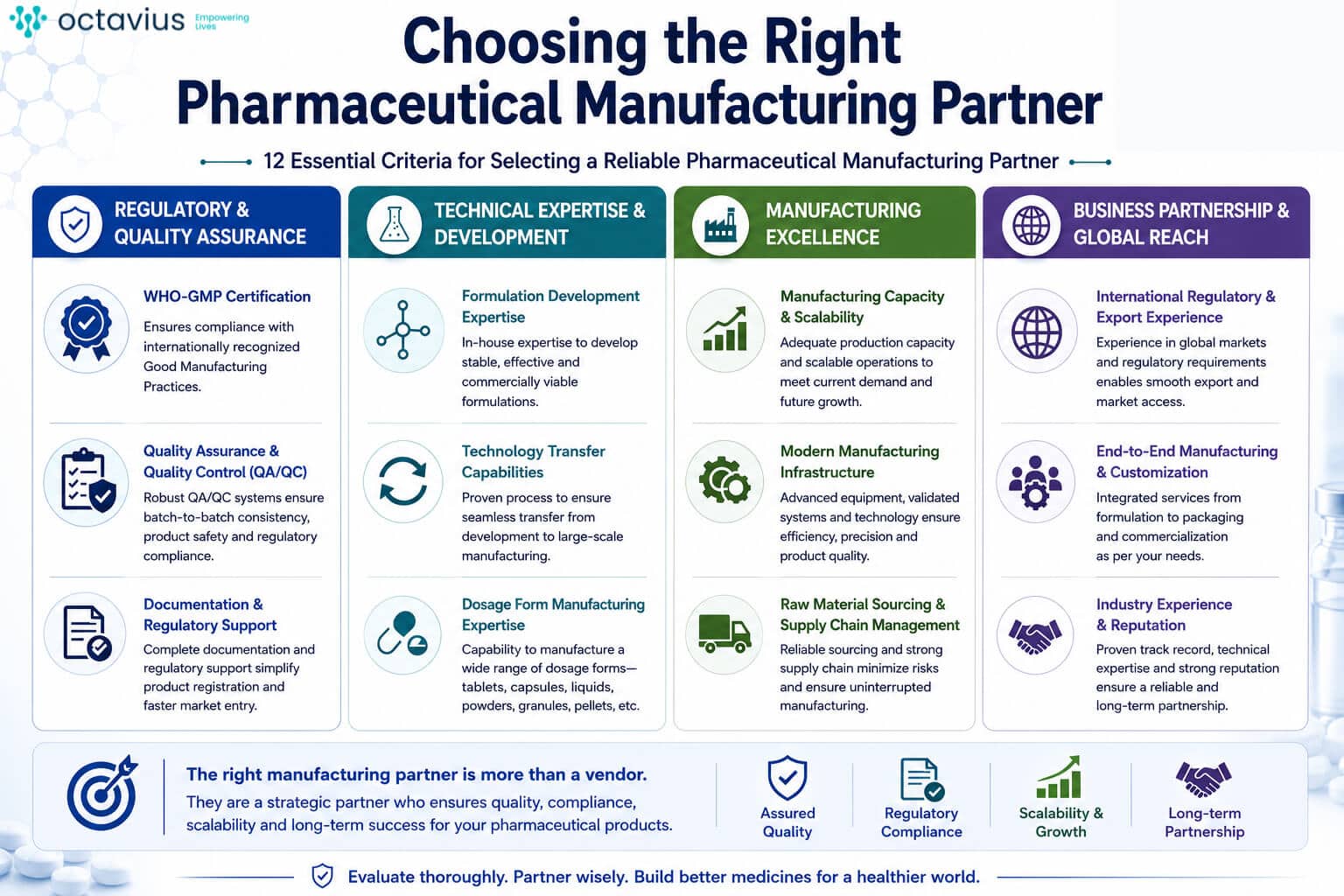
When evaluating a pharmaceutical manufacturing firm, you should take into account:
- WHO-GMP-certified manufacturing facilities to ensure products are produced in accordance with internationally recognized quality standards.
- Formulation development and technology transfer capabilities to ensure a smooth transition from product development to commercial-scale manufacturing.
- Extensive quality assurance and quality control procedures to ensure batch-to-batch consistency and compliance with regulations.
- Manufacturing capacity and scalability to meet the demands of present production and the future growth of the business.
- Experience serving international markets, including regulatory documentation and export support.
A manufacturing partner with these capabilities can assist in simplifying product development, enhancing manufacturing efficiency, and ensuring product quality throughout the product lifecycle.
How Octavius Pharma Supports Pharmaceutical Manufacturing
To succeed in the pharmaceutical industry, a manufacturing company must be able to deliver scientific expertise, robust quality systems, regulatory compliance, and support for products from development through commercial manufacturing.
Octavius Pharma offers integrated pharmaceutical manufacturing solutions to enable pharmaceutical businesses, healthcare brands, and international partners to bring high-quality products to market.
Its capabilities span multiple stages of the pharmaceutical manufacturing process, allowing customers to work with a single manufacturing partner from start to finish.
Key capabilities include:
- WHO-GMP-compliant contract manufacturing for the delivery of high-quality and consistent pharmaceutical products.
- Formulation development services that enable the development of effective and commercially successful formulations.
- Technology transfer capabilities to help transition products from development to commercial-scale manufacturing.
- Qualified sourcing and supplier management for reliable production operations for pharmaceutical raw material outsourcing.
- Production of finished formulations in various therapeutic areas.
- Simplification of the tablet manufacturing process with production of Direct Compressible (DC) granules, which also contributes to manufacturing efficiency.
- Production of herbal and food supplements with stringent quality and regulatory standards.
- Extensive quality management systems with established manufacturing processes, quality assurance, and quality control.
- Global manufacturing capabilities to serve domestic and international pharmaceutical companies.
With scientific expertise, up-to-date manufacturing facilities, and a dedication to internationally recognized quality standards, Octavius Pharma helps pharmaceutical companies bring products to market faster while maintaining product quality and regulatory compliance.
Conclusion
The pharmaceutical manufacturing process is a highly structured and carefully controlled process that transforms scientific research into safe, effective, and high-quality medicines. Formulation development, raw material verification, commercial production, quality assurance, packaging, and distribution each play a vital role in ensuring that pharmaceutical products are produced to the highest regulatory standards and patient expectations.
Partnering with a trusted pharmaceutical manufacturer ensures access to the technical know-how and operational capabilities necessary to successfully take a product from development to commercial production, whether it is a new product, an expansion of production capacity, or entry into international markets.
Octavius Pharma offers complete pharmaceutical manufacturing services such as formulation development, technology transfer, and WHO-GMP-certified contract manufacturing. We have decades of experience in the industry and a strong commitment to quality, which enables us to support pharmaceutical companies in bringing innovative formulations to market while maintaining regulatory compliance.
Talk to our team today about your pharmaceutical manufacturing needs and see how we can assist with your next product journey.
Frequently Asked Questions (FAQs)
What is pharmaceutical manufacturing?
Pharmaceutical manufacturing is the process of producing finished pharmaceutical products by combining active pharmaceutical ingredients (APIs) sourced from qualified suppliers with excipients to create dosage forms such as tablets, capsules, and oral liquids under controlled manufacturing conditions.
What is the pharmaceutical manufacturing process?
The pharmaceutical manufacturing process includes formulation development, raw material procurement, manufacturing planning, granulation or blending, tablet compression or capsule filling, coating (where applicable), quality control, packaging, and commercial distribution.
What are the main stages of pharmaceutical manufacturing?
The major stages include formulation development, raw material verification, manufacturing, in-process quality control, finished product testing, technology transfer, commercial production, packaging, and batch release.
What is formulation development?
Formulation development is the scientific process of designing and optimizing pharmaceutical formulations before commercial manufacturing. It includes pre-formulation studies, excipient selection, analytical method development, prototype formulation, and stability studies.
Why is quality control important in pharmaceutical manufacturing?
Quality control ensures that pharmaceutical products consistently meet predefined specifications for identity, strength, purity, stability, and safety. It helps maintain product consistency while protecting patient health.
What is technology transfer in pharmaceutical manufacturing?
Technology transfer is the systematic transfer of manufacturing knowledge, production processes, analytical methods, and quality requirements from development or one manufacturing site to another, ensuring consistent commercial production.
What is commercial pharmaceutical manufacturing?
Commercial pharmaceutical manufacturing refers to the routine large-scale production of pharmaceutical products using validated manufacturing processes, qualified equipment, and comprehensive quality systems after successful product development.
Why is WHO-GMP certification important?
WHO-GMP certification demonstrates that pharmaceutical products are manufactured under internationally recognized quality standards. It supports regulatory compliance, product consistency, and greater confidence among pharmaceutical companies and international buyers.
How long does pharmaceutical manufacturing take?
The manufacturing timeline depends on product complexity, formulation development, regulatory requirements, batch size, quality testing, and packaging. Commercial production may take several weeks, while new product development can require several months before routine manufacturing begins.
How do pharmaceutical companies choose a manufacturing partner?
Companies typically evaluate manufacturing partners based on their WHO-GMP compliance, formulation development expertise, technology transfer capabilities, quality systems, regulatory support, manufacturing capacity, product portfolio, and experience serving domestic and international markets.